
Shark Moon
N33°6.93' W132°11.25'
0230 ZULU
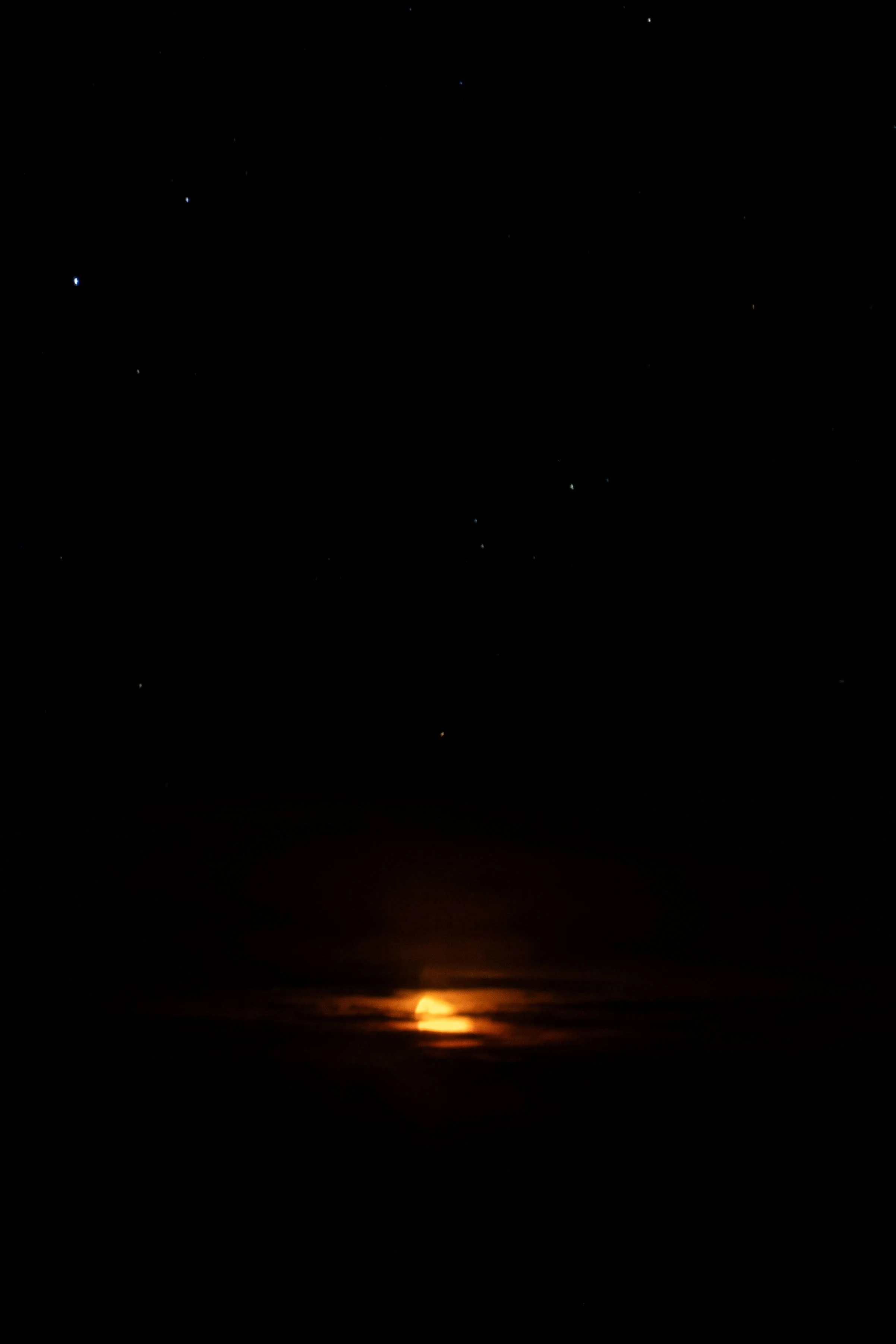
A spot low on the horizon begins to take on a vague orange tint—the details of clouds emerging from a blank canvas of darkness. I recently switched to a new flight bag, and in the dimly lit cockpit of our eastbound jet, I fumble with the unfamiliar clips and zippers securing my camera inside its cavernous volume. With each passing second, as I work through the sequence of getting the camera ready— power switch, shutter speed and aperture, ISO, and manual focus—our wind-driven airspeed and the earth’s rotation towards tomorrow are conspiring to brighten the sky quicker than my fingers can work.
I do some quick mental math on our position—which is still several hundred miles out to sea—as the orange glow spreads horizontally across the base of the sky. Years ago, before the dawn of LEDs, the nighttime cityscapes passing below would slide by in a saturated dream of oranges and yellows and golds… colors created by the sodium vapor lights. Now, the overnight world scrolls by in an impersonal cold hue of blues and whites, which this orange glow most certainly isn’t. Confident that there will be no imminent cries of “land ho,” I set my camera down on the glareshield and wait.
The ooze of light begins to coagulate, forming into a solid orb that slowly drifts upwards behind what were, until only moments ago, the unseen clouds along the horizon. The sky above the cloud line takes on the deep pall of the dark night, as the contrast between dark and light increases. Only bits and pieces of the moon are visible through gaps in the clouds that are now shining in a kind of luminescent orange as the dim light of the moon leaks through the cottony light wisps that are now covering most of the lunar disc. As the moon begins to slide even farther upwards into the heavens, the gaps allowing the unfiltered light to pass through completely close in, the clouds arranging themselves into one solid wall. And as the moon’s light fades into darkness, the cloud wall displays only the merest tint of orange, until even that subtle hue is gone, and in its place once again comes the night sky… a gray void pricked only by the white light of the early evening stars.
Leaning forward, I put my hands on the glareshield and stare into the void ahead. A WestJet 737 that had been inching towards us on the dimmed-out display screen now appears in the distance in real life, 10 miles away and 3000 feet below us—its red beacon—another cold LED—blinking rhythmically in the darkness. The beacon grows brighter as the jet comes closer, the red now joined by the flash of the strobe lights on its wingtips. As the plane passes by underneath us, I can momentarily see the white fuselage and wings as they are bathed in the light of the strobes and beacon for single seconds at a time. Then the lights, and the jet with them, disappear beneath our nose, and the dark void of the night sky returns.
Time rolls on, bringing ever closer the as-yet invisible coastline and eventually our destination, which approaches from the far, far, invisible distance. Stars slide ever higher overhead, dimly lighting the world below in a faint gray wash. And soon, once again, a spot on the horizon, this time higher than before, seems to collect the light. As it takes on an ever-increasing hot white glow, suddenly, in a moment of defiance, the moon pokes through the top of the horizon’s cloud layer, chasing the stars upwards.
For several moments, the moon—its two-thirds crescent appearing like a huge shark’s fin cutting through the ocean of the cloud tops, seems caught in its fight against the grasping tendrils of gravity, unable to avoid the pull of the cloud bank’s top edge yet still managing to splash out an ever-expanding pool of bright white light below it. Then it suddenly breaks free and disassociates itself from its earthly ties, seemingly shrinking back to normal size and luminance as it continues its climb heavenward—yet somehow still holding us under its lunar gaze on our continuing eastward journey and the end of our day.
